
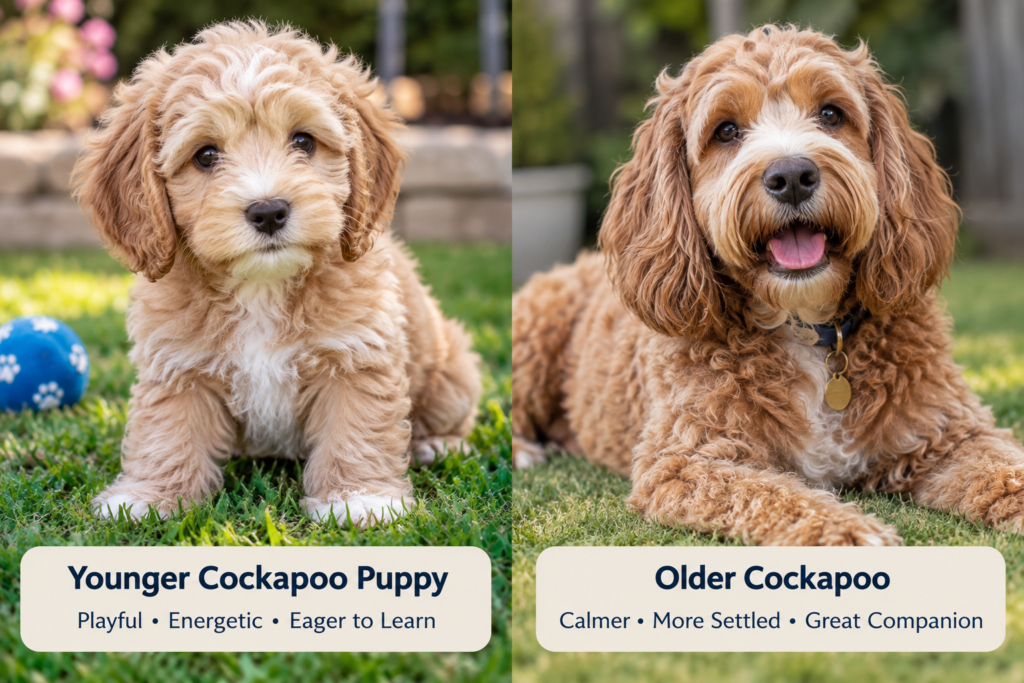
 Older vs Younger Cockapoo Puppies: Choosing for Family Life
Choosing between older and younger Cockapoo puppies is mostly a question of schedule, supervision, and expectations. Younger puppies need frequent toilet breaks and close guidance, while an older puppy may have more established routines but still needs training and patient adjustment. Neither age group is automatically easier for every family. Compare what the individual dog has actually learned, not what its age supposedly guarantees.
Older vs younger Cockapoo puppies: the key differences
A younger puppy offers the experience of guiding early milestones. That also means managing chewing, house-training accidents, safe socialization, and regular rest. A puppy that is several months older may have had more opportunities to practice settling, walking on a leash, or responding to household sounds. Those experiences are not automatic; ask the breeder what was taught and how progress was assessed.
The American Veterinary Medical Association explains that puppies usually require more time for supervision, training, and socialization than adult dogs. It also notes that some older dogs may already know basic commands. But an older *puppy* is not necessarily an adult, and its behavior will still depend on individual development and previous experiences.
Consider an illustrative comparison. A family with someone home throughout the day may welcome frequent puppy breaks. Another family juggling school runs might prefer a dog that has already had some routine practice. Either family still needs a plan for care while everyone is away.
How to prepare for an older Cockapoo’s arrival
Preparation should focus on trust and predictable routines, rather than assuming the dog will settle immediately. The American Animal Hospital Association’s new dog checklist advises establishing household rules, identifying a quiet safe space, and assigning responsibility for feeding, toilet breaks, and training before the dog arrives.
AAHA also recommends keeping the early days calm and limiting visitors so the dog can investigate its surroundings at its own pace. Initial uncertainty does not reveal the dog’s entire personality. Some behaviors become clearer only after the dog has gained confidence in its new home.
Build a first-week plan around five essentials:
- Keep meals and outdoor breaks at predictable times.
- Provide a calm sleeping place away from constant activity.
- Introduce family members gradually and supervise children.
- Reward desired behavior with praise, food, or play.
- Schedule a veterinary review with the dog’s existing records.
An older puppy might still have accidents. Do not treat setbacks as disobedience or proof that earlier training failed. A new home changes the dog’s cues and routine.
What to ask before choosing a mature puppy
Ask how the puppy behaves around visitors, children, other dogs, grooming tools, and normal household noises. Request details about vaccinations, parasite prevention, diet, current toilet habits, and any training provided. Explain your home environment honestly so the source can help identify potential mismatches.
For example, PuffNStuff in Virginia distinguishes its younger and mature puppy categories. Its mature-puppy page describes dogs four months and older and separately lists some training services as optional. That distinction matters: advertised extra training should not be treated as already completed for every dog.
People considering older Cockapoo companions for family life can use that page as a starting point, then confirm each dog’s current age, health records, behavior, and availability directly. Ask for specific observations instead of general statements that every puppy is good with children or other animals.
Avoid common transition mistakes
The first mistake is expecting a mature puppy to behave like a fully trained adult on day one. The second is overwhelming a new arrival with guests, outings, or too many commands. A third is assuming that a prior vaccine record replaces the need for ongoing veterinary advice.
AAHA recommends positive-reinforcement sessions that are brief and easy to repeat. It also emphasizes careful introductions to existing pets and never leaving young children unsupervised with a dog. Consistency is more useful than an intense first-week training schedule.
Frequently asked questions
Is a four-month-old Cockapoo an adult dog?
No. Four months is still puppyhood. A breeder may use the term “mature puppy” for an older age category, but development and training continue.
Are older Cockapoo puppies already house-trained?
Not necessarily. Ask what the puppy has practiced and how reliably it responds in its current environment. Expect some adjustment after moving.
Is a younger puppy better for families with children?
Age alone cannot determine suitability. Consider the individual puppy’s temperament, adult supervision, the children’s behavior, and the family’s time for training.
Should I introduce my new Cockapoo to visitors immediately?
Keep the first days calm. Introduce people gradually, watch for stress, and allow the puppy to approach at a comfortable pace.
Conclusion
Older versus younger Cockapoo puppies is not a contest with one winner. Match the dog’s demonstrated habits to your household’s time and expectations, verify health and training information, and plan a calm transition. The right fit is the puppy whose needs your family can meet consistently.